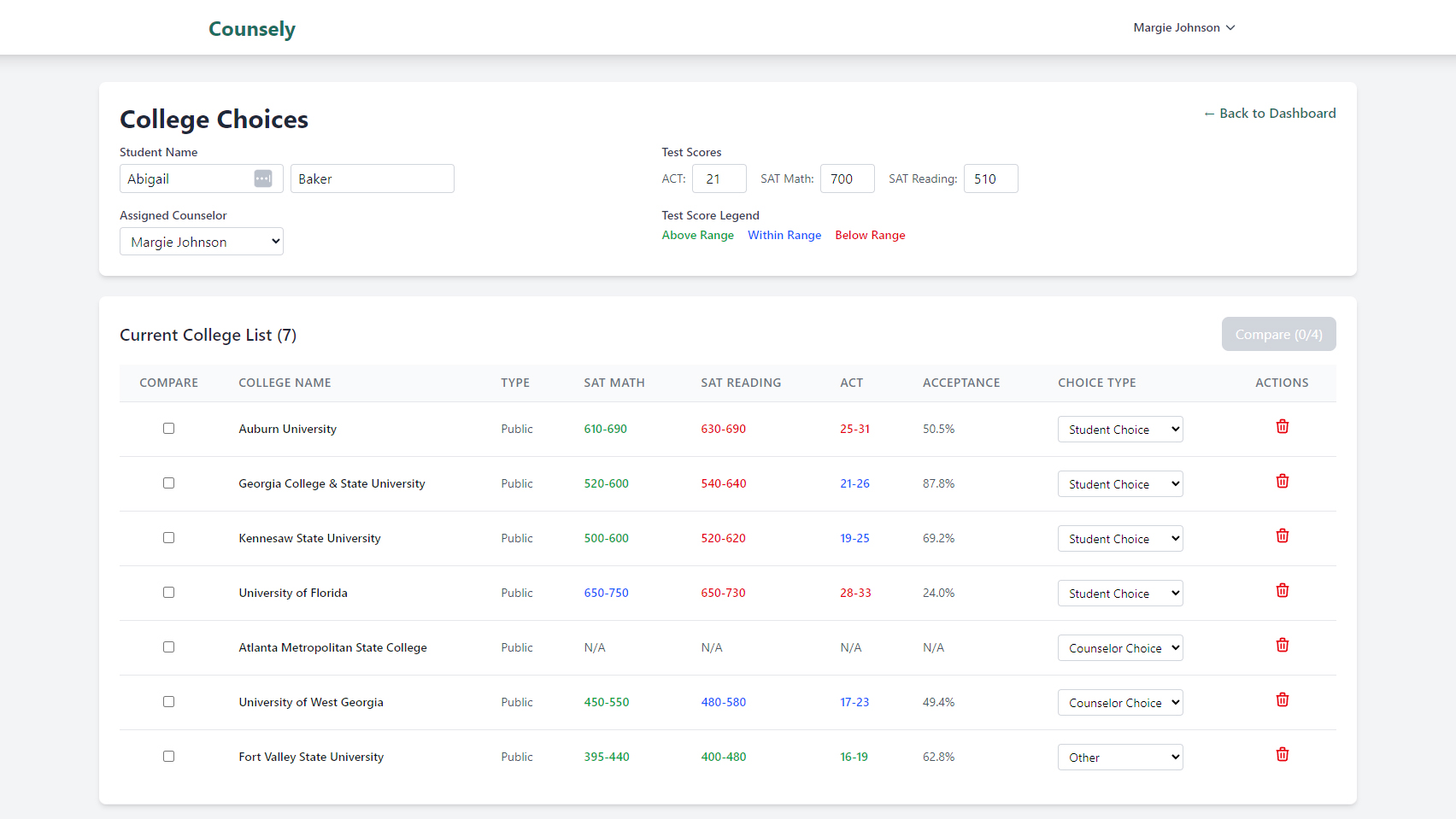
Every counselor has had this meeting. A student walks in with a list of six schools: four are reaches they have almost no chance of getting into, one is a “safety” that isn’t actually safe for them financially, and there’s no target school anywhere on the page. You know how this ends if nobody intervenes, an April full of denial letters and a scramble in May.
“Balanced list” is one of those phrases that gets said in every college night presentation and then never actually gets defined. Reach, target, and safety schools sound simple until you’re trying to explain to a parent why their 3.9 GPA, 1420 SAT student needs more than one “backup,” or why a school with a 70% admit rate might still be a reach for a specific kid.
Here’s a framework that holds up under pushback, from students, from parents, and from your own caseload of 300+ kids who all need this same conversation before December.

What "balanced" actually means
A balanced list isn’t a ratio of school names. It’s a distribution of outcomes the student would genuinely be glad to open in the spring. That distinction matters because it changes what you’re optimizing for — not “does this list have enough safeties,” but “if every reach on this list says no, does this student still have somewhere they want to go.”
The classic three-tier structure is still the right starting point:
Reach schools — where the student’s academic profile is below the middle 50% of admitted students, or the overall admit rate is low enough that even strong applicants are frequently denied (generally under 20%, though this varies by how self-selecting the applicant pool is).
Target schools — where the student’s GPA and test scores land within or near the middle 50% of the admitted class. Admission isn’t guaranteed, but it isn’t a surprise either way.
Safety schools — where the student’s profile is above the middle 50%, admission is highly likely, and — this is the part that gets skipped — the school is one the student would actually attend and can actually afford.
That last clause is why so many “safety schools” fail their one job. A school a student would never enroll in isn’t a safety — it’s a wasted application. And a school that admits the student but doesn’t come close on need-based or merit aid isn’t a safety either. It’s a financial reach wearing a safety costume.

The rule of thirds, with a financial layer
A workable target for most students: 2–3 reach, 3–4 target, 2–3 true safety schools, sized to roughly 7–10 total. Fewer, and one bad admissions cycle can leave a student without options. More, and you’re spending your limited one-on-one time on applications that were never going to get a serious look from the student anyway.
Layer a second axis on top of academic likelihood: cost certainty. For a lot of families, a school’s sticker price tells you almost nothing about what they’ll actually pay. Before a school earns a spot as a safety, check:
- Does the school publish a net price calculator, and has the family actually run their numbers through it?
- Does the school offer automatic merit aid at the student’s GPA/test range, or is aid entirely need-based and unpredictable?
- If this is the “just in case” school, can the family pay the likely net price without a surprise?
A school the student will get into but the family can’t afford isn’t a safety. It’s a reach with different math.

Where counselors get this wrong (even good ones)
Anchoring on admit rate alone. A 65% overall admit rate can still mean a 15% admit rate for out-of-state applicants, or a specific major that’s far more selective than the university as a whole (nursing and computer science programs are frequent offenders here). Always check program-specific and residency-specific data, not just the topline number.
Letting the student’s identity do the work instead of the data. “She’s a strong student, so this is probably a target” is a guess. Pull the actual middle-50% GPA and test range for the specific school and compare it directly. Strong is relative to the applicant pool, not to the rest of your caseload.
Treating test-optional as invisible. At test-optional schools, students who don’t submit scores are often evaluated more heavily on GPA, rigor, and essays — which can shift a school from target to reach or vice versa depending on what the rest of the application looks like. Don’t skip this step just because a score isn’t required.
Building the list once and never revisiting it. A list built in October based on junior-year data should get a second look after fall semester senior grades and any final test scores come in. A school that was a reach in October can become a target by January.

A quick example
Take a student with a 3.6 unweighted GPA, 1280 SAT, interested in business. A rough first pass might look like:
- Reach: A flagship state university with a competitive business program (middle 50% SAT: 1300–1470)
- Reach: A private university known for business (middle 50% SAT: 1350–1500, admit rate 25%)
- Target: A regional public university (middle 50% SAT: 1180–1340, admit rate 55%)
- Target: A mid-size private university with automatic merit aid at this GPA range
- Target: An out-of-state public university with a strong transfer-articulation business program
- Safety: A directional state school with automatic admission above this GPA and guaranteed merit aid
- Safety: A local university the student has visited and would attend, with a net price the family has already confirmed they can cover
Nine schools, three tiers, and — critically — every single one is a place this student would actually be glad to attend. That’s the actual test of a balanced list, not the count in each column.

Where this gets time-consuming, and where it doesn't have to
Building one of these lists well means cross-referencing a student’s GPA and test scores against the admitted-student range at every school under consideration, checking program-specific data, and sanity-checking net price. Doing that by hand for one student is maybe 30–45 minutes if you’re fast. Doing it for a caseload of 300 is the actual reason list-building gets rushed into a single 20-minute meeting instead of the process it should be.
This is the specific problem Counsely’s score-match filtering is built for — it filters Counsely’s full database of 6,400+ colleges down to the ones where a student’s actual GPA and test scores fall in reach, target, or safety range automatically, using the same College Scorecard data referenced above, so the 45-minute research task becomes a five-minute starting point you can walk through with the student in the room.

The conversation that actually matters
The hardest part of this isn’t the data — it’s the conversation when a family wants a list that’s all reach schools, or wants to drop the safety schools entirely because “we don’t need a backup plan.” Two things tend to help:
Frame it in terms of outcomes, not rules. Not “you need a safety school because that’s the process” but “if the two schools you’re most excited about both say no, I want you to still be excited about where you’re going in the fall — let’s find a school like that.”
And show them the data directly. A parent who sees the actual middle-50% range next to their student’s GPA is far more persuaded than a parent who’s told “trust me, this is a reach.” Data de-personalizes the conversation — it’s not you doubting the student, it’s the numbers.